
Every year, EF (Education First) publishes the EF English Proficiency Index (EF EPI), one of the most widely cited English-level rankings in the world, built from the results of people who take its EF SET test online. The 2025 edition places Ecuador 83rd out of 123 countries and regions, with a score of 466 on a 0–600 scale where the global average is 488.
Ecuador's rank in the 2025 EF EPI · score 466 (global average 488)
In the region, countries like Argentina (575, 26th), Peru (519, 52nd), Colombia (480, 76th), and Brazil (482, 75th) all score higher than Ecuador.
Not every skill is equally weak
The EF EPI doesn't give a single number — it measures four skills separately: reading, listening, writing, and speaking. (It doesn't measure "grammar" as its own category; reading is the skill that comes closest to what's traditionally practiced in a grammar-and-reading-focused classroom.) For Ecuador, the breakdown is:
- Reading 488 B1
- Writing 473 B1
- Speaking 456 B1 lowest scores
- Listening 439 A2–B1 lowest scores
Scale 0-600.
Approximate Common European Framework (CEFR) equivalent, based on EF EPI's own score bands.
Source: EF EPI 2025, official Ecuador country page.
Reading, in fact, sits close to the global average (488). But listening is the lowest of the four skills, and speaking isn't far behind. This is a data point, not an explanation — the EF EPI measures outcomes, not causes. What it does show clearly is that the biggest gap isn't in understanding the written language — it's in listening and responding in real time.
Possible explanations (hypotheses, not facts confirmed by EF)
EF doesn't say why this happens — it only measures it. What follows are reasonable readings of the pattern, not conclusions from the source itself:
This pattern may be related, among other factors, to the way English has traditionally been taught in the country. Many people learned English by filling in blanks, conjugating verbs, and translating paragraphs — an approach that trains reading and writing more than speaking or listening. We don't have a source documenting this specifically for Ecuador's education system, so we're presenting it as a plausible explanation, not a verified fact.
There's likely limited exposure to spoken English at real speed. Reading a text gives you time to process each word calmly. A conversation doesn't — your ear needs training to recognize connected speech, accents, and natural rhythm, something rarely practiced in a traditional classroom.
Fear of making mistakes can interfere with speaking before you even get to practice it. This is the factor with the most documented research behind it: psychologists Horwitz, Horwitz, and Cope (1986) described language anxiety as a combination of fear of communicating, fear of being evaluated, and fear of sounding "wrong" in front of others. When that anxiety shows up, it can interfere with a person's ability to access vocabulary they already have — not that it "blocks" it outright, but that it makes retrieving it under pressure harder. That's why so many people who "know" English in theory still freeze when they have to speak it.
What can help you practice
Listening and speaking improve with practice, like any other skill built through repetition. A few ideas, with no promise of guaranteed results:
Practice in short, frequent sessions. There's no evidence they perform objectively better than long sessions, but they're usually easier to stick with over time — and practice you actually keep up with beats a perfect routine you abandon after a week.
Practice without feeling like you're being evaluated. Per Horwitz et al.'s research, this lowers the anxiety that interferes with accessing vocabulary you already know.
Listen and speak in the same exercise, not separately, since that's how they actually happen together in a real conversation.
Practice everyday topics — your city, your job, your routine — instead of isolated vocabulary, so you build sentences on the fly instead of memorizing them.
That's where HelloVozi comes in
Listen
Recognizing connected speech, at real speed, with no pause button.
Recall
Finding the right word under time pressure, not on a study sheet.
Respond
Producing the sentence out loud, with someone waiting for your answer.
This isn't a coincidence or a lack of effort. We built HelloVozi around this specific problem: the gap between understanding English and being able to respond in the moment. Your AI Coach is designed for real spoken practice — listening and speaking at the same time, in short sessions, without the pressure of another person judging every mistake.
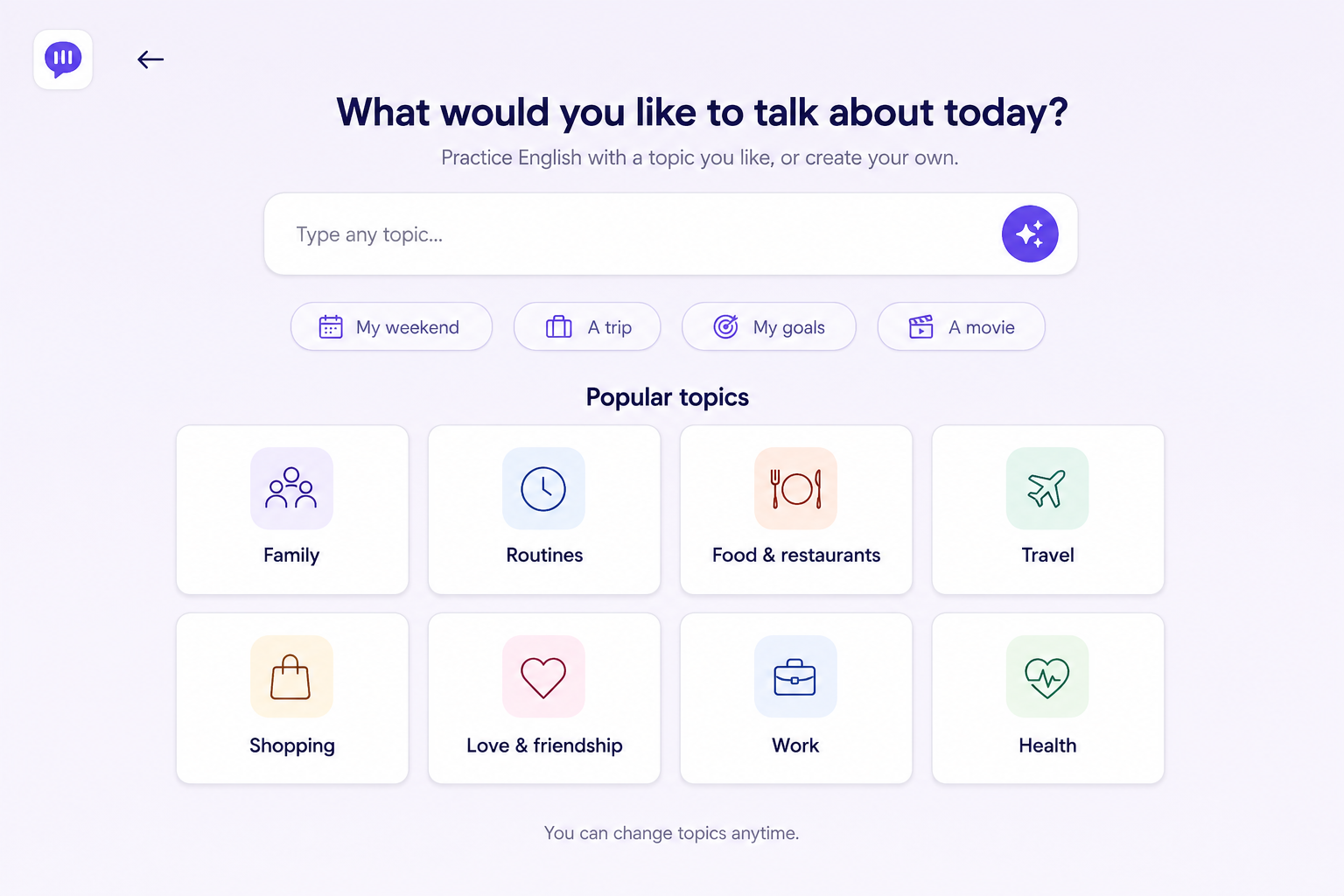
Pick a topic, hit talk, and start speaking. Your AI Coach listens, keeps pace with you, and helps you keep the conversation going — with no one else watching.