 By Vahid Alaghehband
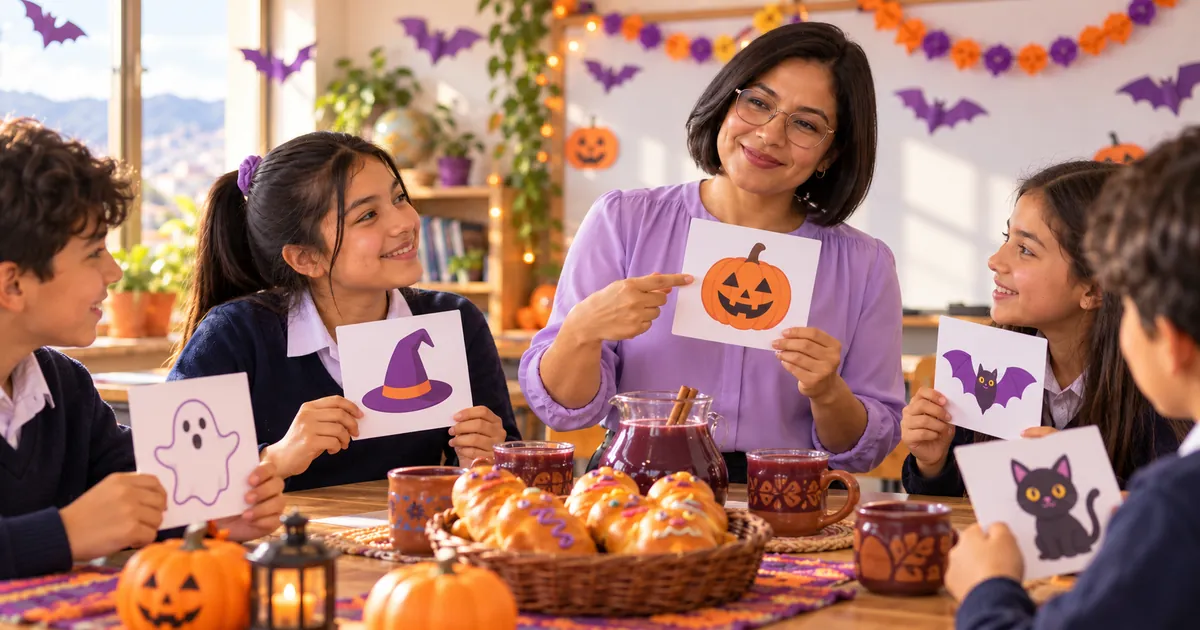
Halloween is celebrated every year on October 31. The name comes from All Hallows' Eve, the evening before All Saints' Day. The most common greeting is Happy Halloween!, and children say Trick or treat! when they knock on doors to ask for candy.
Halloween is one of the easiest topics to practice English with: everyone has something to say about costumes, candy, scary movies or haunted houses. This guide gives you the core vocabulary in groups, the phrases you'll hear at a party or in class, a short reading in simple English and a section most guides skip: how to explain Ecuador's November 2 traditions in English.
What does Halloween mean?
Halloween is a shortened form of All Hallows' Eve, "the evening before All Saints' Day". According to Encyclopaedia Britannica, it's observed every year on October 31. It's written with a capital H because it's the name of a holiday; the older spelling Hallowe'en still appears in some texts.
Halloween vocabulary list
| Word | What it means | Example |
|---|---|---|
| pumpkin | a large, round orange vegetable | We bought a big orange pumpkin. |
| jack-o'-lantern | a pumpkin carved with a face, with a light inside | The jack-o'-lantern is in the window. |
| costume | clothes you wear to look like someone or something else | I'm dressed as a pirate. |
| mask | something that covers your face | She is wearing a mask. |
| candy | sweet food like chocolate (US English; British: sweets) | The kids got a lot of candy. |
| trick-or-treating | going from house to house asking for candy | We go trick-or-treating at six. |
| haunted house | a house where people say ghosts live | The haunted house was really scary. |
| witch | a woman with magic powers in stories | The witch has a black hat. |
| broom | a brush with a long handle | The witch flies on a broom. |
| ghost | the spirit of a dead person in stories | Is there a ghost in the attic? |
| skeleton | all the bones of a body | A skeleton is hanging on the door. |
| vampire | a creature in stories that drinks blood | The vampire has long teeth. |
| zombie | a dead person who walks, in films | He's dressed as a zombie. |
| monster | a big, frightening creature | The monster is green and huge. |
| werewolf | a person who turns into a wolf | The werewolf howls at the moon. |
| mummy | a body wrapped in cloth, from ancient Egypt | The mummy is wrapped in bandages. |
| bat | a small animal that flies at night | A bat flew over the house. |
| black cat | a cat with black fur, a Halloween symbol | A black cat crossed the street. |
| spider | a small animal with eight legs | There's a spider on the wall. |
| cobweb | an old spider web | The room is full of cobwebs. |
| full moon | the moon when it looks like a complete circle | There's a full moon tonight. |
| graveyard | a place where dead people are buried | The party is next to the graveyard. |
| grave | the place where one person is buried | They put flowers on the grave. |
| candle | wax with a string that you light | Light the candle, please. |
| cauldron | a big metal pot | The witch is stirring her cauldron. |
| spell | magic words that make something happen | She cast a spell on the prince. |
| party | a social event with music and food | Are you coming to the Halloween party? |
| decorations | things you put up to make a place look special | We put up the decorations yesterday. |
| scary / spooky | frightening / a little frightening, in a fun way | That movie is really spooky. |
| creepy | strange in a way that makes you uncomfortable | This old house is creepy. |
| carve a pumpkin | cut a face into a pumpkin | Let's carve a pumpkin together. |
| dress up as | wear a costume of someone or something | I'm going to dress up as a witch. |
Examples written by HelloVozi in simple English (A1–A2). In British English people often say sweets instead of candy.
Halloween phrases in English
To wish someone a happy Halloween, say Happy Halloween! Children say Trick or treat! at the door: they ask for a treat (candy), or they'll play a small trick.
| Phrase | When you use it |
|---|---|
| Happy Halloween! | To greet people on the day. |
| Trick or treat! | At a door, when you ask for candy. |
| What are you dressing up as? | Before a party. |
| I'm dressed as a vampire. | To describe your costume. |
| Nice costume! | To give a compliment. |
| That's so spooky! | About a decoration or a story. |
| Are you scared of ghosts? | To start a conversation. |
| Can I have some candy, please? | A polite way to ask. |
A short Halloween reading (A2–B1)
Read it aloud, then try to retell it in your own words without looking.
Halloween is celebrated on October 31. Its name comes from "All Hallows' Eve", the evening before All Saints' Day. Historians connect it with Samhain, an ancient Celtic festival at the end of the harvest. Today, many people wear costumes, go to parties and carve pumpkins into jack-o'-lanterns. Children go from house to house and say "Trick or treat!" to get candy.
Check your understanding: When is Halloween? Where does the name come from? What do children say at the door?
Halloween and the Day of the Dead in Ecuador
They are two different celebrations. Halloween is on October 31. Ecuador's Day of the Dead (Día de los Difuntos) is on November 2, a public holiday to remember family members who have died, with colada morada and guaguas de pan as the traditional foods.
If you live in Ecuador and talk with people from other countries, they'll probably ask about it. These sentences help you explain it:
- In Ecuador, we celebrate the Day of the Dead on November 2. It's a public holiday.
- Families visit the cemetery and bring flowers to remember their loved ones.
- We drink colada morada, a thick, warm purple drink made with purple corn flour, fruit and spices.
- We eat guaguas de pan, sweet bread shaped like babies. "Guagua" means "baby" in Kichwa.
- Halloween is a different celebration. Some people have Halloween parties, but the Day of the Dead is more traditional here.
More about November 2: the Day of the Dead in Ecuador: colada morada and guaguas de pan.
Halloween activities for kids learning English
For beginners (A1–A2), at home or in class. You only need paper, a pencil and, if you like, a phone to record.
- "What am I?" One child picks a word from the list and gives clues: I'm black. I can fly. I live in a cave. The others guess: Are you a bat?
- Halloween spelling. Choose 10 words (pumpkin, ghost, witch, candy, costume…), say them aloud and ask the children to spell them. It's a good warm-up for a spelling bee.
- Describe your costume. Each child records 30 seconds using the model I'm dressed as… My costume is… It's scary/funny because… and then listens back.
Practice Halloween English with HelloVozi
With Vozi Bee you practice spelling English words by level. With Vozi Coach you can talk by voice or text about your costume or this weekend's party, and with Vozi Missions you practice a real situation, like buying a costume or inviting friends to a party.
Explore Vozi Bee →Read next: Spelling Bee words by grade and English conversation topics by level.
In December: continue with Christmas vocabulary in English.
Next step: if you don't know your level, take the English level test (about 15 minutes, with instant results). To keep working on this topic, see Vozi Bee's spelling bee practice by level.
Frequently asked questions
What does Halloween mean?
It's a shortened form of All Hallows' Eve, the evening before All Saints' Day. It's celebrated every year on October 31.
How do you spell Halloween?
H-A-L-L-O-W-E-E-N, with a capital H. The older spelling Hallowe'en is still seen sometimes, but Halloween is the usual form today.
What do you say on Halloween?
The usual greeting is Happy Halloween! Children say Trick or treat! when they knock on doors to ask for candy.
What does "trick or treat" mean?
It means "give me a treat (candy), or I'll play a trick on you". Today it's simply the phrase children say when they ask for candy.
Is Halloween the same as the Day of the Dead?
No. Halloween is on October 31. In Ecuador, the Day of the Dead (Día de los Difuntos) is on November 2, a public holiday when families remember their loved ones and share colada morada and guaguas de pan.