 By Vahid Alaghehband
The speaking practice gap is the difference between the time a learner needs to develop fluency and the minutes they can actually speak during a shared lesson. Cambridge English uses guided learning hours to estimate progress between levels; those hours include lessons and supervised study, not conversation alone.
It is easy to assume that slow progress in spoken English means you are not working hard enough. Before blaming yourself, consider two separate questions: how much guided learning a level may require, and how much individual speaking time truly fits inside a class. That is why it helps to add minutes outside class and practice English speaking with AI at your own pace.
How long does it take to improve spoken English?
Cambridge English estimates roughly 200 guided learning hours to move from one CEFR level to the next. The actual time varies with age, intensity, prior experience, and exposure outside lessons. From complete beginner to C2, its cumulative guideline is 1,000 to 1,200 hours.
The figure is a guideline, not a universal clock. Cambridge notes that language-learning background, study intensity, age, and exposure outside lesson time can speed up or slow down progress. “Guided learning” also covers lessons and supervised study across several skills; it does not represent hours devoted exclusively to speaking.
Cambridge English's estimate for moving from one full CEFR level to the next. Individual results can vary.
One class hour is not one hour of individual conversation
A group lesson also uses time for explanations, reading, writing, assignment review, classroom organization, and questions. Speaking time is shared. A learner can therefore attend classes for years while accumulating far fewer minutes of spoken production than they might expect.
Speaking turns are shared. The more people who participate, the less time may be available for each learner to formulate complete answers.
A lesson develops several skills. Grammar, reading, writing, and listening matter, but they compete for the same block of time.
Practice outside class is often irregular. If speaking only happens during scheduled lessons, accumulating hundreds of hours can take much longer.
How to add more practice without adding another burden
You do not need to close the entire gap in one session. The aim is to create sustainable additional opportunities to produce language, receive a response, and continue the interaction.
Use short, frequent sessions. Ten minutes may fit more easily into a routine and, when repeated, increase accumulated speaking time.
Change the context. Practicing everyday, academic, and personal topics requires you to retrieve vocabulary in different situations.
Combine listening and responding. Conversation requires you to understand, decide, and produce an idea without depending on a worksheet.
Turn a few spare minutes into a conversation adjusted to your level.
Choose a topic with Vozi Coach →If you understand English but freeze when you speak, read why understanding English isn't enough to speak it; and if you wonder how much time to spend each day, see how many hours a day you should study English.
How HelloVozi complements classroom learning
Available
Practice when you have time instead of waiting for a turn within a group.
Adaptable
Choose a suggested topic or write your own according to your level and interests.
Continuous
Answer by voice or text and receive a follow-up question that keeps the exchange moving.
HelloVozi does not replace a teacher. It expands the space available for practice between lessons: learners can converse with Vozi Coach, complete guided missions, and apply what they have learned with a frequency that can be difficult to provide individually inside a large group.
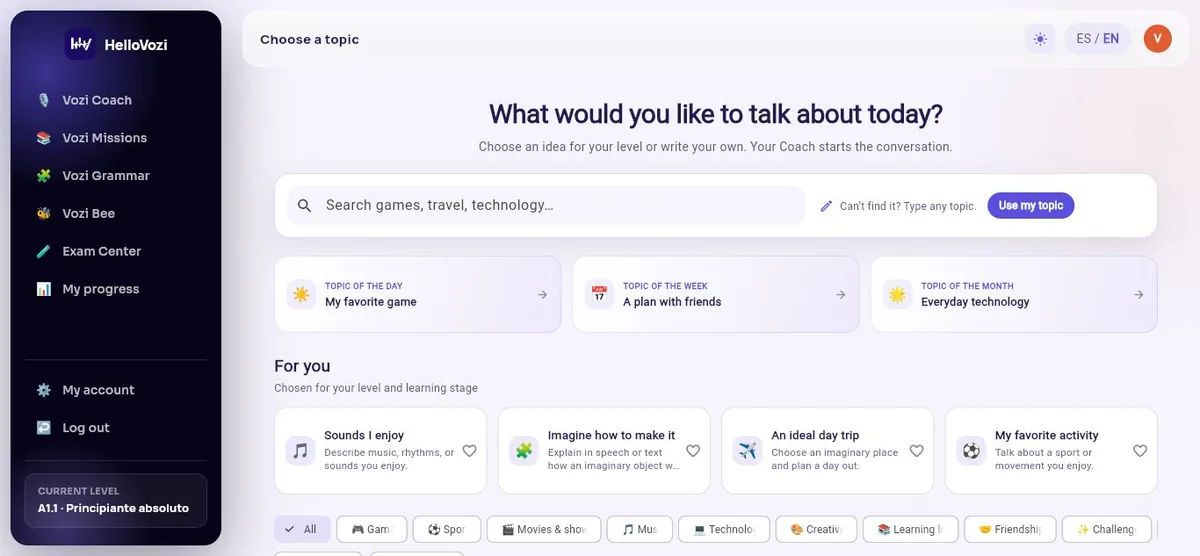
Choose a topic and start speaking. Vozi Coach adjusts the conversation to the configured level and keeps the practice moving through follow-up questions.
Next step: if you don't know your level, take the English level test (about 15 minutes, with instant results). To keep working on this topic, see Vozi Missions' English role-play missions.
Frequently asked questions
How long does it take to improve spoken English?
Cambridge English estimates approximately 200 guided learning hours to move from one CEFR level to the next. It is a guideline, not a promise: prior experience, study intensity, age, and exposure outside lessons can all change the time a learner needs.
Why is one class hour not one hour of speaking practice?
Because class time includes explanations, reading, writing, organization, and participation from the entire group. When many learners share a lesson, each person's individual speaking time can shrink to only a fraction of the session.
Do short speaking practice sessions help?
They can help learners accumulate practice outside the classroom when used consistently. They do not replace every form of learning or guarantee a specific timeline, but they create more chances to speak and can make the habit easier to fit into a daily routine.
Does HelloVozi replace an English teacher?
No. HelloVozi complements a teacher's work by providing additional opportunities to converse by voice or text, practice different topics, and receive support during a session. Its role is to expand the practice time available, not replace a teacher's pedagogical guidance.